Time-varying Electromagnetics (10)

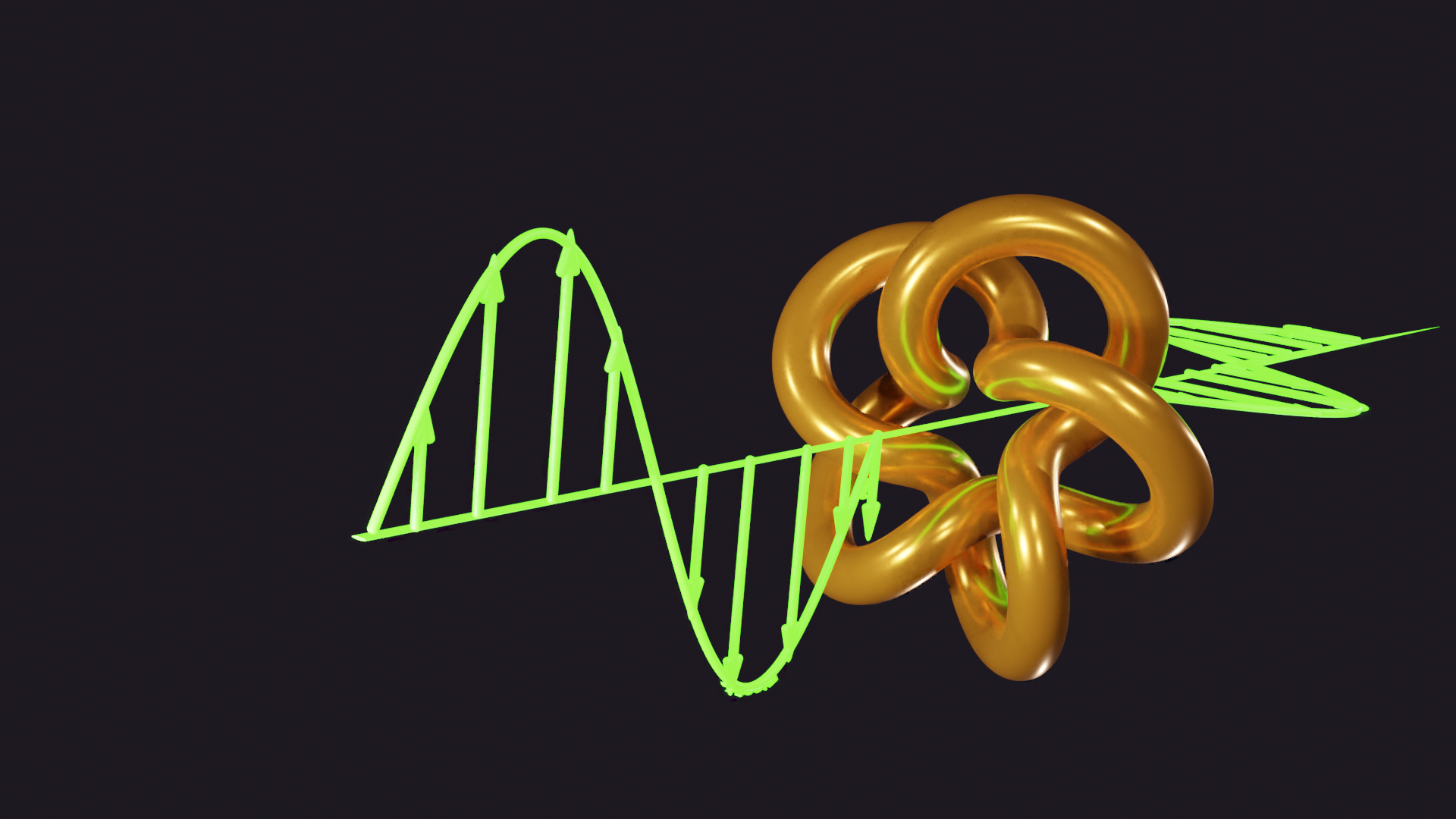
Chiral balls: Knotted structures with high order symmetry and their unique electromagnetic properties

In physics, geometrical symmetry is a fundamental property of importance since it is associated with physical conservation. Here, we reveal an exceptional form of symmetry for a family of knots that are both chiral and three-dimensional (3D) rotationally symmetric about every axis of a standard Cartesian coordinate system. We call these unique knotted structures chiral balls. Moreover, chirality can bring about polarization transformation in electromagnetic waves. As a consequence of their 3D rotational symmetry, we further expect the polarization transformation performance of chiral balls to exhibit ultra-wide angle-independent behavior. Such a remarkable property has not been previously reported on in…

Continue reading...

Wave-number domain analysis for determining the response of linear space-invariant time-varying systems

System response analysis is a powerful method for analyzing linear time-invariant (LTI) systems. In this work, we have demonstrated that a system response approach can also be applied to analyze the so-called linear space-invariant (LSI) but time-varying problems, which represent a dual of the conventional LTI problems. In this proposed approach, we perform a Fourier transform of the electric field distribution on the space coordinate, rather than in time, and express it in the wave-number domain. Specifically, we express any input signal and its corresponding output in the wave-number domain. Then, the transfer function for the LSI time-varying system can…

Continue reading...

Fundamental Asymmetries between Spatial and Temporal Boundaries in Electromagnetics

Time-varying materials bring an extra degree of design freedom compared to their conventional time-invariant counterparts. However, few discussions have focused on the underlying physical difference between spatial and temporal boundaries. In this letter, we thoroughly investigate those differences from the perspective of conservation laws. By doing so, the building blocks of optics and electromagnetics such as the reflection law, Snell’s law, and Fresnel’s equations can be analogously derived in a temporal context, but with completely different interpretations. Furthermore, we study the unique features of temporal boundaries, such as their nonconformance to energy conservation and causality. Read more Wending Mai, Jingwei…

Continue reading...

Temporal multi-stage energy pumping

As an important theoretical concept, temporal boundaries provide researchers with new insights for tailoring electromagnetic waves in the time domain. Because a temporal boundary breaks the time translation symmetry, a source is necessary to satisfy energy conservation. In this Letter, we quantify the relationship between refractive index contrast and the required energy exchange. More specifically, to realize a temporal boundary with a large refractive index contrast, a correspondingly large and abrupt energy exchange is required. Considering this practical difficulty, we propose to mimic a large-contrast temporal boundary by staggering a series of small-contrast temporal boundaries separated by carefully designed durations.

Continue reading...

Generalized Temporal Transfer Matrix Method: A Systematic Approach to Solving Electromagnetic Wave Scattering in Temporally Stratified Structures

Opening a new door to tailoring electromagnetic (EM) waves, temporal boundaries have attracted the attention of researchers in recent years, which have led to many intriguing applications. However, the current theoretical approaches are far from enough to handle the complicated temporal systems. In this paper, we develop universal matrix formalism, paired with a unique coordinate transformation technique. The approach can effectively deal with temporally stratified structures with complicated material anisotropy and arbitrary incidence angles. This formulation is applied to various practical systems, enabling the solution of these temporal boundary related problems in a simple and elegant fashion, and also facilitating…

Continue reading...

Analytical transient analysis of temporal boundary value problems using the d’Alembert formula

Temporal boundary value problems (TBVPs) provide the foundation for analyzing electromagnetic wave propagation in time-varying media. In this paper, we point out that TBVPs fall into the category of unbounded initial value problems, which have traveling wave solutions. By dividing the entire time frame into several subdomains and applying the d’Alembert formula, the transient expressions for waves propagating through temporal boundaries can be evaluated analytically. Moreover, unlike their spatial analogs, TBVPs are subject to causality. Therefore, the resulting analytical transient solutions resulting from the d’Alembert formula are unique to temporal systems. Read more Wending Mai and Douglas H. Werner

Continue reading...